

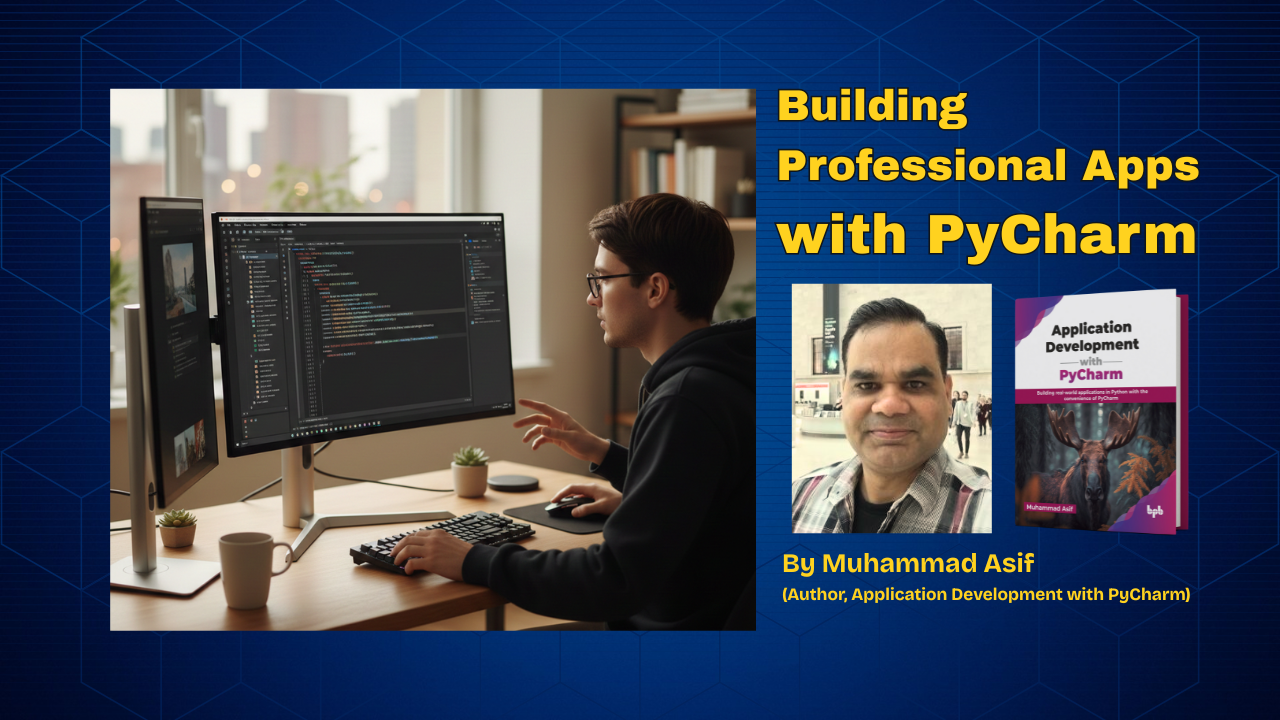
Application development with PyCharm
Application development with PyCharm — Making Python adoption simple with the right tools and structured learning strategy
By Muhammad Asif
Python is known as one of the easiest programming languages to learn. Many beginners can write basic scripts with it. However, they often struggle to develop practical, real-world applications. This is not because of Python's syntax or its various libraries. In fact, Python's syntax and structure are very intuitive. The main challenge for new learners is the lack of proper tools and guidance during learning.
Initially, learners use simple code editors or online environments. These are useful for starting quickly, but they soon find that these tools support only basic scripts. As projects grow, debugging becomes time-consuming. Managing dependencies with external libraries also gets tedious. Without a professional development environment, learning Python can become more difficult than necessary.
This is where PyCharm, a powerful Integrated Development Environment (IDE), becomes important. The book Application Development with PyCharm offers a structured learning path. It covers core Python concepts and shows how to build applications using PyCharm's features.
Why using PyCharm
Many resources suggest using IDEs as secondary tools. This book takes a different approach. It promotes learning Python with a modern IDE like PyCharm. PyCharm helps you write code faster. It also enables you to organize your project, manage environments and dependencies, debug, and control versioning.
At first, PyCharm might seem intimidating, but it actually makes learning easier. When used correctly, it helps you complete development tasks quickly and efficiently. A few such tasks are highlighted here:
- Suggesting better code through intelligent completion
- Highlighting mistakes before you execute your code
- Tracking execution flow during debugging
- Simplifying complex tasks like managing various virtual environments
- Analyzing data for building data pipelines
- Building and visualizing charts
What this book focuses on
Application Development with PyCharm is structured to learn Python hand-in-hand with PyCharm. It bridges the gap between learning the language and applying it professionally.
The book focuses on:
- Learning core Python concepts through practical, hands-on examples
- Using PyCharm features to accelerate learning and productivity
- Building real applications, not just small scripts
By using PyCharm throughout the learning process, learners gain a structured, efficient, and realistic development experience.
Structured learning strategy
What separates a good Python book from fragmented online tutorials is its structure and learning path. This book is organized with a structured learning approach in mind. It is divided into thirteen chapters. These chapters guide readers from foundational concepts to how they work together in real applications.
The book starts with an introduction to code editors and IDEs. It explains why PyCharm stands out for Python development. Readers are then guided through installing, configuring, and customizing PyCharm on Windows, macOS, and Linux. Special attention is given to explaining the various virtual environments available for Python and how to set them up in PyCharm.
Once PyCharm and virtual environments are covered, we focus on Python fundamentals, including variables, data types, various containers and collections, control structures, functions, modules, and object-oriented programming. When explaining data types and control structures, we emphasize not only understanding the concepts but also how Python treats them internally. By using practical code examples and PyCharm-assisted inspection tools, you will see how data (values) are stored, modified, and passed when working with primitive and collection data types.
Python is not a mainstream object-oriented programming language. It is essential not only to understand OO concepts but also how they work in Python and how the Python interpreter enforces them. All these are explained and elaborated using PyCharm, which simplifies and enhances these concepts with its set of inspection and analysis tools.
After covering the fundamentals, the book shifts focus toward application development. You will be introduced to the building blocks of web development, including HTTP, web servers, WSGI, and popular web development frameworks such as Flask, Django, and FastAPI. A dedicated chapter provides a deep dive into building a web application with the Django framework. This chapter also shows how PyCharm simplifies project structure, navigation, and debugging.
A database is a core component of any web application. Working with databases is covered using both direct SQL and ORM approaches. The two options provide a well-rounded understanding of how data persistence is handled in PyCharm. Various code examples with step-by-step details help you understand the benefits and complexity level of using direct SQL and ORM.
The later chapters explore Python’s powerful role in data engineering and data science. You’ll learn how to build data pipelines using NumPy and Pandas, inspect and debug data effectively within PyCharm, and visualize insights using Matplotlib, Seaborn, and Plotly. All these tasks can be performed within the PyCharm environment.
Finally, the book wraps up with a comprehensive discussion on version controls, explaining how modern development workflows rely on tools like Git and how PyCharm integrates seamlessly with them.
Who should read this book
This book is suitable for beginners to intermediate Python learners. It is also ideal for software engineers and data professionals. Readers wanting to apply Python confidently and work on real projects will benefit. The book is valuable for those who want to move beyond theory and seek more than scattered tutorials or even paid online training courses. It helps avoid setup pitfalls and adopt professional tools.
Final thoughts
Python is a powerful language. With the right tools, you can use this powerful language to develop powerful applications as well. The book Application Development with PyCharm provides a clear, practical learning roadmap. It helps you leverage PyCharm's full potential.
Through structured explanations, hands-on examples, and intuitive tools, this book equips you to build real-world Python applications. Whether starting your Python journey or refining your workflow, it offers an efficient path forward.


Leave a comment
This site is protected by hCaptcha and the hCaptcha Privacy Policy and Terms of Service apply.