

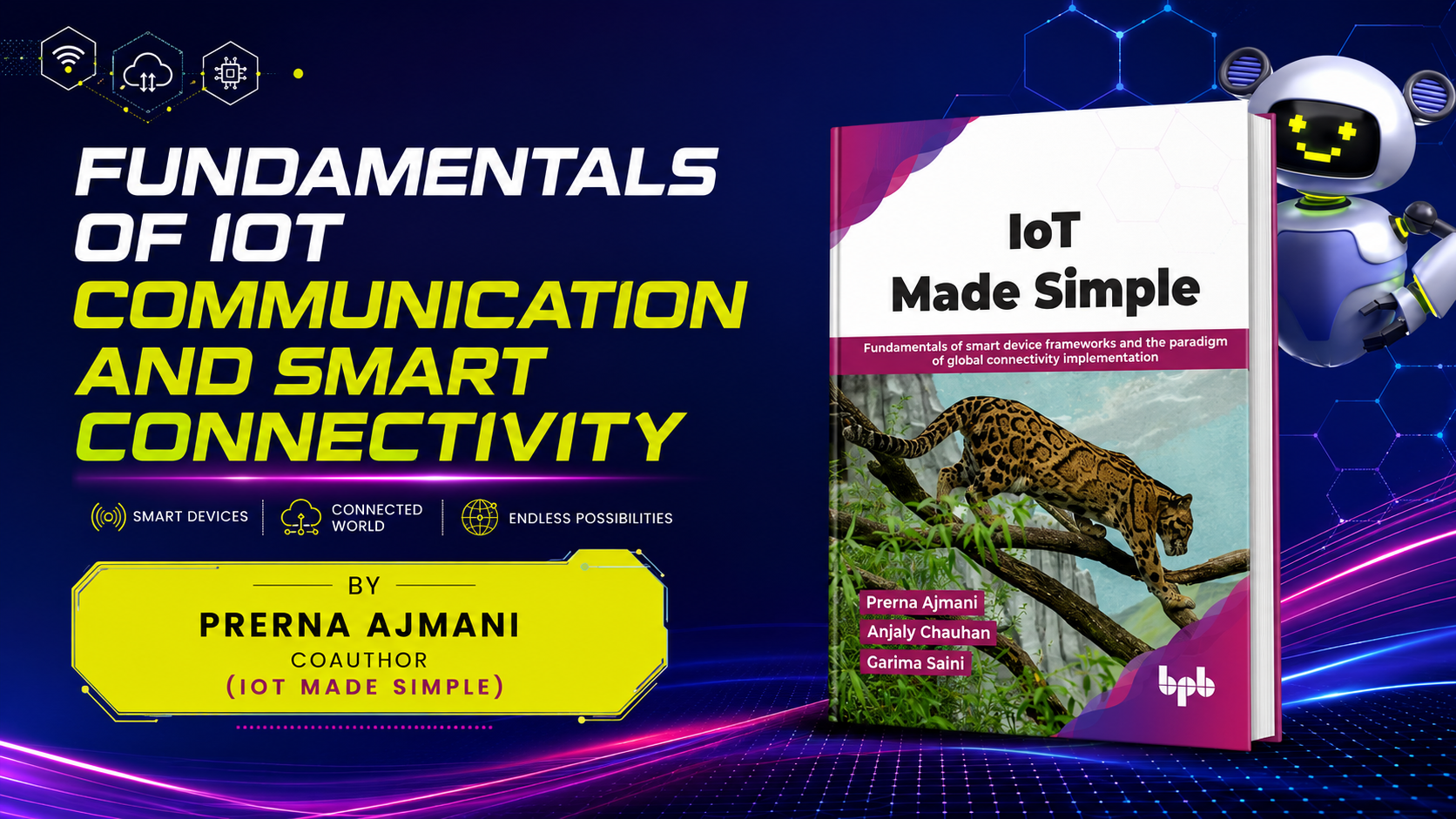
IoT Explained: Making Sense of the Connected World
By – Prerna Ajmani
(Co-Author , IoT Made Simple)
The world today is no longer silent. All around us, billions of everyday things such as refrigerators, streetlights, cardiac monitors, industrial turbines, and many more are constantly whispering data to each other. We are living in a time when the physical and digital worlds have blended into a living and seamless ecosystem. This change is driven by the Internet of Things (IoT).

Getting into the world of IoT, however, can be pretty daunting for many developers, students, and technology enthusiasts. The IoT makes you go outside. Traditional software development is all about your code existing completely inside of a structured, predictable screen. It means understanding the relationship between physical hardware and embedded software. These wireless protocols can transmit data in noisy environments, and cloud platforms can process millions of real-time data packets.
This layered complexity often discourages brilliant minds from experimenting. That challenge is exactly what inspired me to write IoT Made Simple (published by BPB Publications). The aim of the book, and this article, is to cut through the scary jargon and offer a clear and accessible way for anyone to build, prototype, and deploy smart connected systems.
The Core Conflict: Why IoT Feels Overwhelming For
When you begin to learn software development, you will find that writing a simple "Hello, World!" program takes only a few lines of code. With IoT, however, your very first project needs a combination of three different disciplines.
Electrical Engineering: You need to understand voltage, current, sensors, actuators, and how to wire up microcontrollers safely.
Network Engineering: You need to figure out how a small chip, with limited power, can connect to Wi-Fi, manage IP addresses, and send data around the internet.
Cloud & Data Engineering: You need a place to store, visualize, and react to incoming sensor data in real-time.
Requiring a beginner to learn circuit design, C++ embedded programming, network protocols, and cloud databases all at once inevitably causes cognitive overload. They end up debugging a loose wire on a breadboard, not sure if the problem is in their physical hardware, their microcontroller code, their Wi-Fi connection, or their cloud configuration.
To overcome this friction, we must view IoT not as a tangle of wires and code, but as a clean, layered stack of simple, modular parts.
The Three-tier Architecture Plan

No matter how complex a successful IoT system is, it can be broken down into three basic layers. The first step to making any project easier is to understand this architectural blueprint.
- The Perception Layer (The Senses): This is the physical edge of your system. Sensors gather analog data from the environment (temperature, humidity, motion, heart rate), and microcontrollers convert this data into digital signals. Actuators (motors, relays, LED displays) perform physical actions based on decisions.
- The Network Layer (The Nervous System): This layer transports the digital signals. It includes communication technologies like Wi-Fi, Bluetooth, Zigbee, and LoRaWAN, along with lightweight application protocols designed to route data reliably over unstable networks.
- The Application Layer (The Brain): This is where the data lands. Cloud platforms, local servers, and dashboards process the incoming data, run predictive analytics (often powered by Machine Learning), trigger alerts, and send commands back down to the actuators at the edge.
By dividing your project into these three distinct zones, debugging becomes straightforward. If your cloud dashboard isn't updating, you can isolate the issue: Is the sensor reading the data correctly? Is the network transmitting the packet? Or is the cloud database failing to parse it?
Demystifying Hardware at the Edge
A major barrier to entry for many has historically been the cost and complexity of hardware. Fortunately, the open-source hardware revolution has completely leveled the playing field.
Today, low-cost microcontrollers have made hardware prototyping incredibly accessible. In IoT Made Simple, we focus heavily on platforms like the ESP32 and Arduino. The ESP32, in particular, is a game-changer. For the price of a cup of coffee, it offers dual-core processing power, built-in Wi-Fi, Bluetooth, and dozens of input/output pins to interface with sensors.
To make hardware simple:
- Start with Digital Sensors: Analog sensors require calibration and noise filtering. Digital sensors (like the DHT11 for temperature/humidity or the HC-SR04 for distance) communicate using simple digital protocols, making them far easier for beginners to read.
- Embrace Breadboarding: You do not need to solder custom circuit boards to build a working prototype. Breadboards and jumper wires let you quickly assemble and modify circuits without permanent changes.
Deciphering the Language of Things: Protocols
Once your hardware is reading data, it needs to talk to the outside world. Traditional web protocols like HTTP are incredibly heavy. An HTTP request carries a lot of header metadata, which drains the battery of low-power edge devices and wastes precious network bandwidth.

To make communication efficient, IoT relies on lightweight, specialized protocols:
- MQTT (Message Queuing Telemetry Transport): Operating on a publish-subscribe model, MQTT is the undisputed gold standard for IoT. Instead of devices constantly hitting a server with requests, they publish data to "topics" on a central broker, and any subscriber (like a dashboard or database) receives that data instantly. It is incredibly lightweight and designed to survive high-latency or unstable connections.
- CoAP (Constrained Application Protocol): Essentially a lightweight version of HTTP designed specifically for constrained devices operating on low-power networks, allowing them to use standard GET, POST, PUT, and DELETE commands with minimal overhead.
Understanding how to set up an MQTT broker and write your first pub-sub script is like unlocking a superpower; it suddenly makes your devices feel truly connected and responsive.
Unleashing the Power of the Cloud
Data is only valuable if you can understand it and act upon it. Sending sensor readings into a black hole of raw code won't help you optimize a greenhouse, monitor a patient, or manage an electric vehicle's battery.
This is where IoT cloud platforms come into play. Platforms like ThingSpeak, Adafruit IO, and major enterprise suites like AWS IoT provide the infrastructure to:
- Collect and log data points over days, weeks, or years.
- Generate beautiful, real-time visual charts and gauges.
- Create conditional logic (e.g., “If temperature exceeds 30°C, send an email alert and trigger the cooling fan relay”).
By leveraging these platforms, you don’t have to build complex web servers from scratch. You can focus on building your physical device and trust the cloud to handle data visualization and management.
Looking Ahead: The Convergence of AI and IoT (AIoT)
As we look to the future, the scope of IoT is expanding rapidly. The next frontier is AIoT, the fusion of Artificial Intelligence and the Internet of Things.
Traditionally, IoT devices were dumb sensors that sent raw data to the cloud for heavy lifting. But with the rise of Edge AI, we are now deploying compact, pre-trained neural networks directly onto microcontrollers. Devices can now run local computer vision, voice recognition, and anomaly detection without needing a continuous internet connection. This reduces latency, saves bandwidth, and dramatically improves security and privacy.
Furthermore, integrating IoT with the UN Sustainable Development Goals (SDGs), such as building smart agriculture grids to conserve water, using wearable IoT sensors to make healthcare accessible, and designing smart energy grids for Electric Vehicles (EVs), proves that IoT is no longer just a hobbyist's playground. It is the toolset we will use to build a sustainable, efficient, and resilient future.
Your Invitation to Build
The beauty of the Internet of Things is that it is fundamentally creative. It is the only branch of technology where your code directly affects physical reality, where a line of software can physically open a window, turn on a motor, or save a life.

IoT Made Simple was written to strip away the gatekeeping around this technology. You don’t need a PhD in electrical engineering or decades of software experience to build something meaningful. All you need is a curious mind, a cheap microcontroller, and a structured, step-by-step roadmap to guide you.
The connected future is actively being built right now. The only question left is: What will you build?

%0AThe%20world%20today%20is%20no%20longer%20silent.%20All%20around%20us,%20billions%20of%20everyday%20things%20such%20as%20refrigerators,%20streetlights,%20cardiac%20monitors,%20industrial%20t...)
Leave a comment
This site is protected by hCaptcha and the hCaptcha Privacy Policy and Terms of Service apply.