

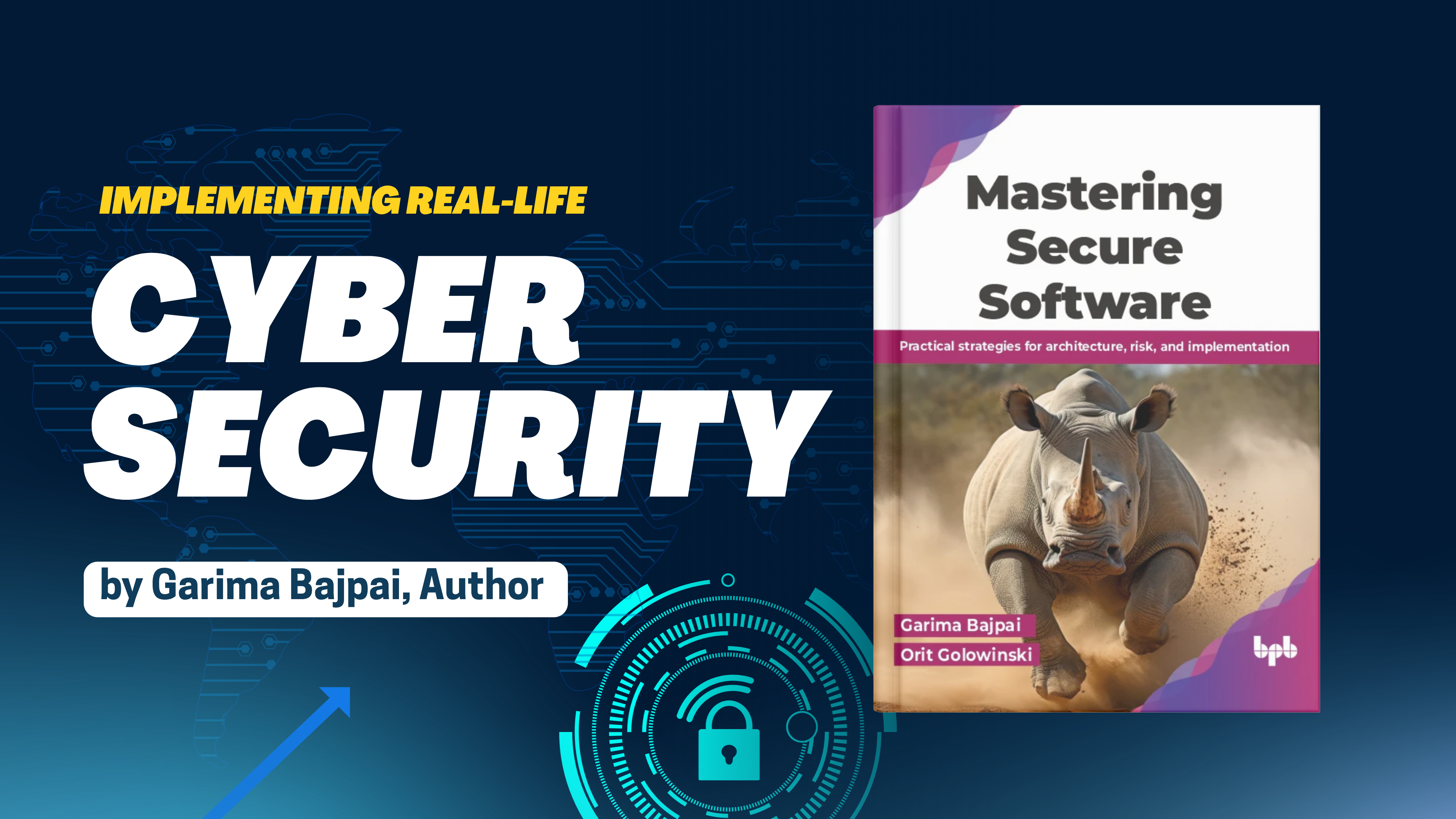
Mastering Secure Software Leadership
Unlock Mastering Secure Software:
A Call to Executive Action
By: Garima Bajpai
(Author, Mastering Secure Software)
As technology leaders, we navigate AI transformations and rising cyber threats. Insecure software architecture poses a critical risk to our digital strategies. It stays hidden during board meetings and planning sessions. It emerges from rushed designs, unclear dependencies, third-party integrations without oversight, and ignored data flows. These issues only surface during major breaches, outages, or failed audits. By then, the impact hits hard as business interruptions, reputational damage, high remediation costs, and lost stakeholder trust that takes quarters or years to recover.
In my own career journey spanning roles in AI risk management, DevOps strategy, and software leadership, I’ve witnessed this pattern play out repeatedly across enterprises and public sector organizations. I’ve sat in war rooms during incident responses where a single architectural oversight, like an inadequately segmented microservices boundary or an unvetted AI model integration, snowballed into millions in remediation expenses, extended incident response cycles stretching weeks, and regulatory scrutiny. What often gets labeled as a “technical issue” in post-mortems is, at its core, a strategic risk, fragile architectures that throttle how quickly we can modernize legacy systems, adopt generative AI at scale, or credibly assure our boards and regulators that we’re building for resilience in an era of pervasive threats.
This painful reality is precisely the context in which Mastering Secure Software: Architecture to Implementation, co-authored with a team of industry experts in security architecture, DevOps, and AI governance, was born. This isn’t just another dense tome filled with checklists of firewalls, encryption algorithms, or compliance tick-boxes. It’s a practical blueprint tailored for C-suite executives, VPs of Engineering, and digital transformation leads who intuitively grasp that security must be woven into the very DNA of their software architecture, not treated as an afterthought or a departmental silo. The book bridges the gap between high-level strategy and actionable implementation, equipping you with frameworks to directly connect architectural choices to tangible business risks, regulatory exposures, operational efficiencies, and long-term value creation. In doing so, it reframes security from a dreaded cost center to be perpetually optimized downward into a strategic enabler that unlocks faster innovation, stronger competitive moats, and investor confidence.

Why Secure Architecture is the New Executive Mandate
Let’s be blunt, traditional “security by bolt-on” approaches, retrofitting controls, scheduling periodic penetration tests, or layering on compliance tools, are relics of a pre-AI, pre-cloud-native world. They fail spectacularly in today’s environment, where software isn’t static monoliths but dynamic ecosystems of APIs, serverless functions, AI agents, and multi-cloud data flows. Secure architecture, by contrast, demands a proactive mindset: aligning threat modeling with business outcomes from the outset. This means rigorously mapping what truly needs protection (critical assets like customer PII or proprietary AI models), defining clear trust boundaries (e.g., between your core services and external vendors), scrutinizing data flows end-to-end, and anticipating how AI components, whether LLMs or autonomous agents, amplify both value creation and attack surfaces.

Drawing directly from my hands-on community leadership, where I’ve facilitated workshops for hundreds of practitioners on AI technical debt, cloud governance, and secure DevOps practices through Canada DevOps + AI Community of Practice, Ottawa’s AWS User Groups, and Women in Tech initiatives, this book distills those real-world lessons into tools executives can wield immediately. You won’t find abstract theory instead, expect executive dashboards that visualize architectural risk in terms of revenue impact or downtime probability, decision frameworks for prioritizing controls based on business velocity, and ROI narratives that quantify how a 20% reduction in technical debt correlates to 30% faster feature releases. For busy executives, the real power lies in empowering you to ask and answer the right questions that cut through technical jargon:
- Are our architectures designed to contain failure and limit blast radius? In a world of interconnected services, a vulnerability in one pod shouldn’t take down your entire platform.
- How does our AI strategy change our threat landscape and compliance obligations? Generative AI introduces novel risks like prompt injection or model poisoning; we map these to architectural safeguards that preserve innovation speed.
- Where is technical debt today creating tomorrow’s cyber incidents? Using debt radars and migration playbooks, identify hotspots like legacy APIs or shadow IT before they ignite.

Championing Secure-by-Design in High-Stakes Sectors
Executives in regulated sectors, public services, finance, and healthcare know the dual pressure all too well. They move fast to deliver citizen-facing apps or digital banking, but stay bulletproof against compliance. I’ve spent years engaging practitioners in these spaces through my community events, watching teams struggle with the tension between agility and assurance. A shared architectural language, as outlined in the book, dissolves this as business stakeholders articulate risk appetites, security teams model threats, and engineers implement patterns, backed by visuals and templates.
Leaders don’t just read this book; they champion “secure-by-design” mandates that embed into culture. Start with executive sponsorship: tie architecture gates to OKRs, reward teams for vulnerability bounties, and make secure patterns part of promotion criteria. Over time, this elevates boardroom conversations:
Mastering Secure Software meets you exactly here, depth without drowning in detail. Gain enough architectural literacy to challenge your, guide CISOs, and mentor Chief AI/Data Officers.
The Strategic Payoff: Building for Tomorrow’s Dominance
Ultimately, Mastering Secure Software: Architecture to Implementation invites executive leaders to reframe security, not as a barrier to speed but as the foundation for trustworthy AI and cloud adoption. When architectures are secure by design, magic happens:
- Scale without fragility: Deploy globally with confidence, auto-scaling under attack.
- Comply effortlessly: Audits become check-offs, not scrambles.
- Recover swiftly: Incidents localize, minimizing downtime to hours, not days.
- Innovate boldly: AI experiments thrive in safe sandboxes, accelerating time-to-market.

This is an investment in your strategy’s durability, the ability to weather storms, seize opportunities, and outpace rivals shackled by legacy risks. As a co-author and community builder, I’ve poured my frontlines experience, high-stakes deliveries, and the Canadian vibrant tech scene into every page. Whether you’re a CIO plotting an AI roadmap, a VP of Engineering scaling DevOps, or a CEO eyeing M&A, this book arms you to lead.
Unlock your advantage: Get your copy, pilot a chapter at your next offsite, and turn secure architecture into a proven edge.

%0AAs%20technology%20leaders,%20we%20navigate%20AI%20transformations%20and%20rising%20cyber%20threats.%20I...)
Leave a comment
This site is protected by hCaptcha and the hCaptcha Privacy Policy and Terms of Service apply.