

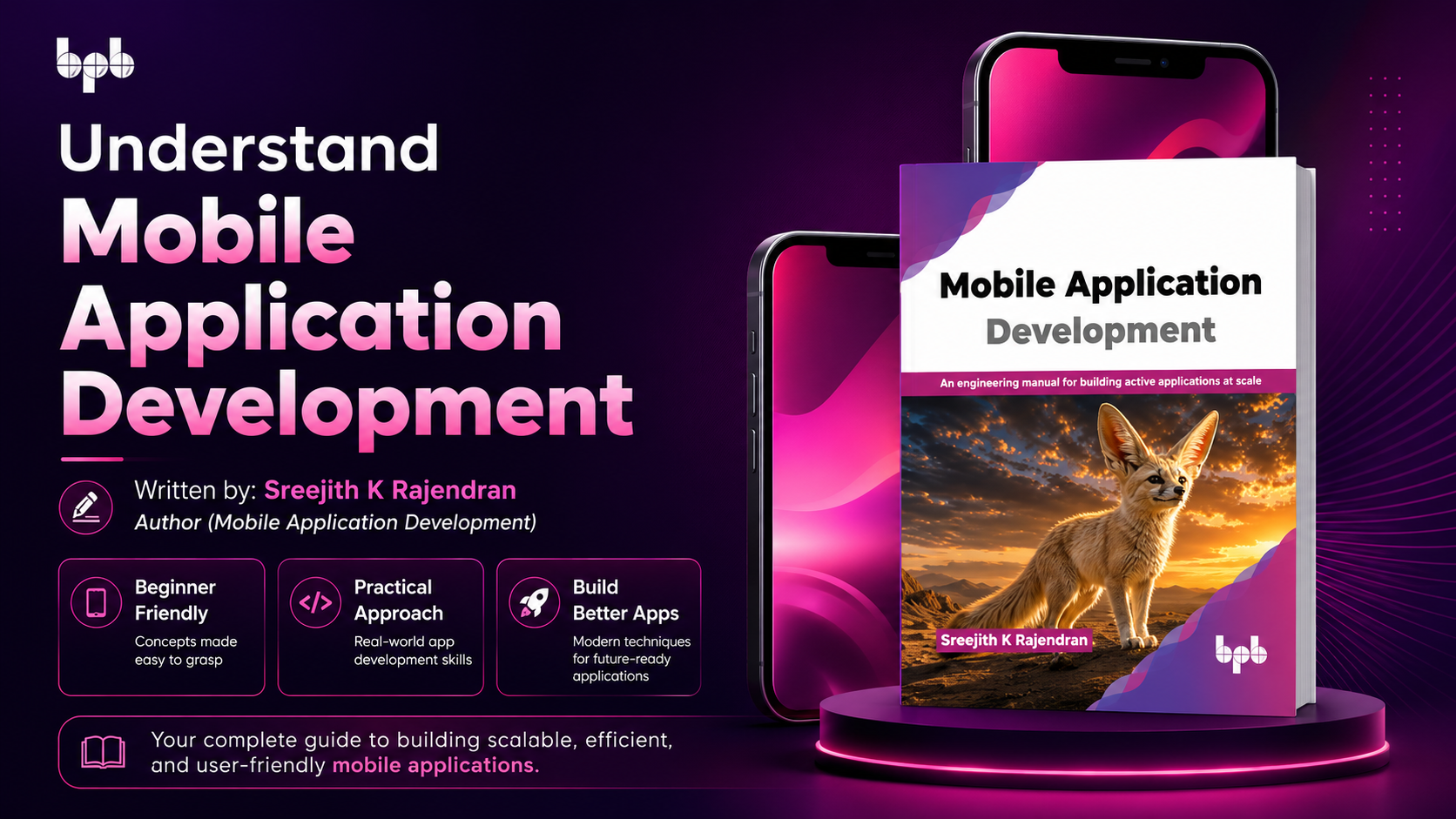
Mobile Application Development - Engineering in the AI era
By: Sreejith K R
(Author , Mobile Application Development)
AI has reduced the difficulty of producing code, but it has not eliminated the need for engineering judgment. Mobile developers therefore need to understand not just how to write code, but how to design, operate, release, evolve, and lead mobile products.
One should understand that AI changes the economics of implementation, but it does not remove the economics of decisions. This write-up attempts to seed the idea and show how the book will add value to the mobile application development journey.
Let us start with a real-life situation where an enthusiast comes in and asks to build a mobile application. The expected outcome is well articulated to the GenAI, and all necessary details specifying the product requirements are established. A beautiful app is created and can be taken to production. Life would have been simple if this is what actually happens on the ground. Empirical evidence from a couple of engagements suggests that the previous approach works for a minimum viable product. But the moment the application needs to scale for business, AI becomes an individual productivity booster and an accelerant for development effort. AI is a double-edged sword: when it hallucinates (e.g., wrong API usage, fabricated library methods, incorrect assumptions about business logic, etc.), it can have a negative impact. The right balance is key to a scalable, great mobile application.

Mobile application development brings its own fun. An individual can get caught up with a biased and incorrect view that a mobile application is all about building a facade. In today's world, people exploring a career in mobile app development may not have the time to keep up with the industry's accelerated expectations. The AI era has made it even more competitive, as anyone with access to a computer can now bring ideas to life with a few prompts. What differentiates the solution generated from these prompts is a carefully engineered and optimal mobile application. Development in the AI era should ensure relevant structures so the codebase is scalable and usable. One can observe that an individual with tacit knowledge of a domain and the technology under development can accelerate their skill with GenAI to produce faster, more expected outcomes. Acquiring such tacit knowledge, which earlier would have taken years of grinding, is now expected out of the individual in a short time. Thus, one may require investment and the investigative mindset to beat the odds. The individual who can attain this goal will be competent in concept-to-code as the modus operandi for delivering solutions and results.
This book, Mobile Application Development, covers the engineering principles required to excel, lead, and sustain any consumer-facing mobile application for enterprise. Let's get into the technicalities of mobile application development. Anyone who decides to take up mobile development may see it as just another system, but with the added constraint of distributed computing. The mobile app is also powered by a battery, which makes it portable.

These add constraints to design decisions for the mobile application built. Remaining concerns are similar to any software development platform. A specialist in mobile application development may be aware of the nitty-gritty details of the platform, which is the differential learning that helps ensure the application follows platform standards. A mobile device is a computing device that has an operating system running on top. The development toolkit that enables external parties to build and ship applications is the mastery one may have to acquire.
What can mobile application development offer?
Mobile application development can bring a sense of identity and intellectual growth. Individuals who take up mobile application development, along with systemic thinking, are guaranteed to experience this growth. This trait can easily transfer to software engineering and help you learn other disciplines. This power enables individuals to become polyglots. Learning should be treated as an enjoyable journey, with its own ups and downs, milestones, and personal transformation.
How to approach the learning journey?
As a branch of engineering, mobile application development represents a continuous journey of learning, exploration, and innovation. While individuals may have personal preferences for certain platforms or technologies, professional growth requires an openness to the broader mobile ecosystem rather than limiting oneself to a single platform. A well-rounded mobile developer embraces diverse technologies, approaches, and challenges to develop a deeper understanding of the discipline.
These four pillars will help define the roadmap to become effective in mobile development.

- Programming language + framework/tools
- Project management + team management.
- Release process, collaboration ecosystem, and mechanism to automate
- Best practices, community learning, and case study.
The book Mobile Application Development is based on the above.
This write-up aims to keep you informed about what mobile application development can offer. Approaching the role systematically can accelerate your technology career and build holistic, systemic thinking. This approach will help you become a well-rounded engineer who can build, learn, adapt, and lead in an increasingly AI-driven software industry, starting with specialization in mobile application development.



%0AAI%20has%20reduced%20the%20difficulty%20of%20producing%20code,%20but%20it%20has%20not%20eliminated%20the%20need%20for%20engineering%20judgment.%20Mobile%20developers%20therefore%20...)
Leave a comment
This site is protected by hCaptcha and the hCaptcha Privacy Policy and Terms of Service apply.