

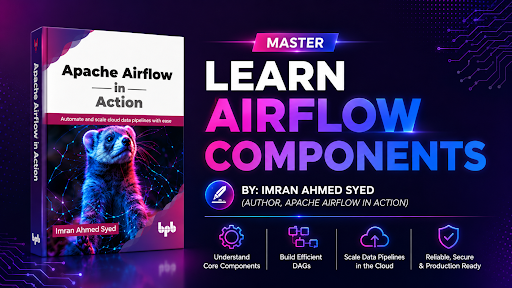
Navigating the world of Apache Airflow: From core foundations to the latest 3.0 version
By: Imran Ahmed Syed
(Author , Apache Airflow in Action)
If you have spent any real time working with data, you know the feeling. Everything is going smoothly, until a random pipeline breaks at 2:00 AM because an upstream job silently pushed a null value or a database query timed out.

We have all been there. Managing data pipelines is not just about writing clever Python scripts; it's about keeping the entire operational plumbing intact as business needs and data volumes grow.
In today's modern data stack, Apache Airflow has solidified its place as the undisputed industry standard for workflow orchestration. Whether you are moving millions of records in batch ETL, triggering real-time machine learning inference, or feeding executive dashboards, Airflow is the engine that keeps data moving reliably.
That is precisely why this book was written: to serve as a complete, grounded guide to mastering Airflow, from fundamental concepts and production best practices all the way to the exciting shifts coming in version 3.0
Why Apache Airflow matters in the Data ecosystem
Data engineering has evolved rapidly over the last decade. As architectures migrated from monolithic on-premise databases to distributed cloud data warehouses and lakes, the need for programmatic, reliable workflow management became critical.
Airflow changed the game by introducing Data Pipelines as Code. By defining workflows in pure Python, data teams gained the ability to:
- Version control their operational logic using Git.
- Build complex dependency graphs that automatically handle failures, retries, and alerts.
- Maintain complete visibility over their entire data estate through a centralized UI.
- Integrate seamlessly with any cloud service, database, or analytics tool via a vast ecosystem of provider packages.
Whether you are running a single local instance or scaling orchestrations across cloud providers like AWS, GCP, or Azure, understanding Airflow's core architecture is an essential skill for any modern data practitioner.
What you will learn in this book
This book is structured as a progressive roadmap. We start with the absolute fundamentals, build up to advanced production patterns, and conclude with a forward-looking view of where orchestration is headed.
1. Fundamentals & local setup (chapters 1 & 2)
We begin by exploring Airflow’s history and core architecture, including the Scheduler, Executor, Webserver, and Metadata Database, and its role alongside tools like Dagster and Prefect. You’ll then walk through step-by-step installation options using Docker, Python virtual environments, and cloud quickstarts, learning how to configure airflow.cfg for performance and logging.
2. Core orchestration mechanics (chapters 3, 4 & 5)
Master the anatomy of Directed Acyclic Graphs (DAGs). You will learn to construct clean execution logic using bitshift operators, Jinja templating, and essential operators (PythonOperator, BashOperator, SQLOperator, DockerOperator). We also break down scheduling parameters, cron expressions, backfills, catchup mechanisms, and event-sensing strategies.

3. Monitoring & enterprise operations (chapters 6 & 7)
Building pipelines is only half the battle; maintaining operational visibility is the rest. You will learn to navigate the UI, inspect task states, troubleshoot logs across local and remote storage, and set up failure alerts. We also evaluate managed services like AWS MWAA, Google Cloud Composer, and Astronomer, complete with cost-optimization strategies and migration checklists.

4. Advanced development & Airflow 3.0 future (chapters 8, 9 & 10)
Unlock advanced design patterns including XComs, dynamic DAG generation, custom plugins, RBAC security, and the REST API. Then, we bridge into the future: Chapter 9 provides a comprehensive look at Airflow 3.0's service-oriented architecture, the modern React UI, the @asset decorator, and the Task SDK. Finally, in Chapter 10, you put everything together in a hands-on project to write, test, and deploy a production-ready pipeline.

Who is this book for?
This guide was crafted to be practical, approachable, and immediately actionable:
- Beginner to intermediate Data Engineers: Looking for a clear, structured path to mastering Airflow from scratch.
- Data Scientists & ML Engineers: Wanting to automate model training, scoring, and data prep pipelines with confidence.
- Data Architects & Analysts: Seeking to understand how workflow orchestration fits into their broader platform strategy.
Ready to elevate your Data orchestration?
Data engineering does not have to be a daily exercise in firefighting. With a solid grasp of foundational patterns and a clear view of where the technology is heading, you can build clean, reliable pipelines that run smoothly day in and day out.
Grab your copy, step through the practical code examples, and master the art of data orchestration!
%0AIf%20you%20have%20spent%20any%20real%20time%20working%20with%20data,%20you%20know%20the%20feeling.%20Everything%20is%20going%20smoothly,%20until%20a%20random%20pipeline%20breaks%20at%202:0...)
Leave a comment
This site is protected by hCaptcha and the hCaptcha Privacy Policy and Terms of Service apply.