Article: Reclaiming Digital Trust: How DIDs and Zero-Knowledge Proofs Are Rewriting Identity Architecture
Reclaiming Digital Trust: How DIDs and Zero-Knowledge Proofs Are Rewriting Identity Architecture
By: Aiyan ma
(Author, Decentralized Identity and Zero-Knowledge Proofs)
Every time you click "Sign in with Google" or upload a photo of your driver’s license to verify your age, you are making a silent trade-off: convenience for vulnerability. Centralized identity providers hold the keys to our digital lives, while static credentials leak across data breaches every single day.
The fundamental problem isn't that security systems are failing; it's that our traditional identity architecture is broken. Traditional authentication models rely on static identifiers, centralized databases, and over-sharing of personal attributes. Digital identity rests on a fundamental paradox: to prove who we are, we routinely surrender our privacy.

Why The Identity Paradigm Must Shift
In traditional IAM (Identity and Access Management), authentication is explicit and centralized. To prove you are over 21, you reveal your full name, home address, and exact date of birth to a third party. To authenticate a device or service, you expose long-lived secrets or rely on centralized identity providers (IdPs).
Decentralized Identity—anchored by W3C Decentralized Identifiers (DIDs) and Verifiable Credentials (VCs)—flips this model on its head by enabling Self-Sovereign Identity (SSI). Instead of relying on a centralized server to validate who you are, trust is decentralized across verifiable data registries.
However, DIDs and VCs solve only half the problem: ownership and portability. To achieve true privacy, we need modern cryptography: Zero-Knowledge Proofs (ZKPs).
The Magic of Zero-Knowledge: "Proof Without Exposure"
Zero-Knowledge Proofs let a Prover mathematically convince a Verifier that a statement is true—without revealing any underlying data beyond the statement's validity.

Combining DIDs with ZKPs enables game-changing privacy primitives:
- Selective Disclosure: Prove you hold a valid driver’s license without revealing your home address.
- Predicate Verification: Prove your income exceeds $50,000 or your age is without disclosing the exact figures.
- Unlinkability: Prevent aggregators and verifiers from correlating your digital footprint across different services.
The Building Blocks: DIDs and Credential Foundations
At the base of decentralized identity is the Decentralized Identifier (DID). Unlike traditional identifiers (such as email addresses or usernames tethered to a single platform), a DID is a globally unique URI anchored to a distributed ledger, peer-to-peer network, or cryptographic registry.
A DID resolves to a machine-readable DID Document, which contains:
- Public Cryptographic Keys: Used for signature verification and authentication.
- Verification Methods: Defining how the DID holder proves ownership.
- Service Endpoints: Enabling secure, direct peer-to-peer communication channels.
When an issuing authority—such as a government agency, university, or enterprise—verifies a user's attributes, it issues a Verifiable Credential (VC). This credential contains cryptographically signed claims about the holder (e.g., employment status, academic degrees, or age). The holder stores this VC locally inside an encrypted digital wallet under their exclusive control.
The Cryptographic Friction: Why Native Signatures Fail ZK
While Verifiable Credentials provide a portable foundation of trust, they present a major architectural hurdle for privacy: standard digital signatures are not ZK-friendly.
Traditional signature schemes (like Ed25519 or secp256k1 ECDSA) rely on bitwise operations and modulo arithmetic that are computationally prohibitive—and often intractable—to execute natively inside a Zero-Knowledge arithmetic circuit (such as R1CS or AIR constraints). Proving that an issuer signed an attribute inside a ZK circuit using standard ECDSA would require hundreds of thousands of constraints, blowing up memory footprints and destroying client-side proving performance.
Statement Transformation: Bridging the Gap
To make credentials compatible with succinct ZKPs, modern architectures introduce a Statement Transformation phase:
- ZK-Friendly Signatures: Systems replace or augment standard signatures with pairing-friendly schemes like BBS+ or Idemix. BBS+ signatures allow a user to selectively disclose subsets of signed attributes while generating a single, privacy-preserving proof of validity without revealing undisclosed fields.
-
Cryptographic Accumulators & Merkle Commitments: Alternatively, credential attributes or large registries can be committed to a Merkle Tree or Sparse Merkle Tree (SMT). The issuer signs the overall Merkle Root rather than every individual attribute.

The Unified Workflow: How DIDs and ZKPs Interlock
When a holder interacts with a verifier, the three components operate in a seamless pipeline across three distinct phases:

Architectural Breakdown of the Workflow
- Decentralized Resolution: The verifier does not call a centralized verification API. Instead, it extracts the issuer's DID from the proof context, resolves the Issuer's DID Document on-chain, and retrieves the corresponding public key to verify the signature framework.
- Local Zero-Knowledge Execution: The user’s wallet computes the proof locally on their device. It feeds private inputs—raw credential attributes, the Merkle authentication path, and secret blinding factors—into the ZK circuit as a private witness.
- Unlinkable Presentation: The output is a succinct, zero-knowledge proof. Because dynamic cryptographic blinding factors are applied during computation, presenting this proof to Verifier A cannot be correlated with presenting a proof to Verifier B, eliminating cross-site tracking and profiling.
A New Paradigm for Digital Trust

To solve this systemic vulnerability, a new architectural paradigm has emerged—one that unifies W3C Decentralized Identifiers (DIDs) and Zero-Knowledge Proofs (ZKPs). Together, these cryptographic primitives shift digital identity away from corporate honeypots and return control directly to the individual, establishing a framework where users retain absolute digital autonomy while verifiers receive deterministic mathematical certainty.
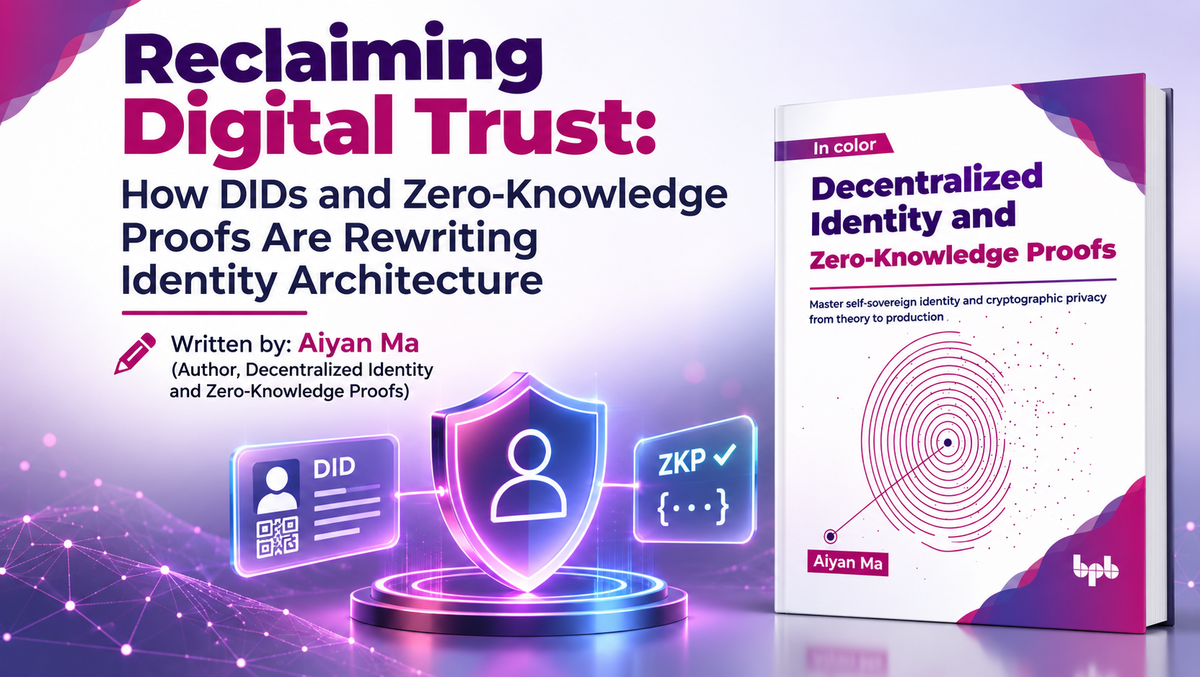
I’m thrilled to share that my latest book, Decentralized Identity and Zero-Knowledge Proofs (published by BPB Publications), is now officially available. This book bridges high-level cryptographic theory and hands-on, production-grade identity architecture.
Integrating DIDs and Zero-Knowledge Proofs is more than an incremental upgrade to our security stacks; it is a fundamental shift in how we architect digital systems. By leveraging DIDs for decentralized key management, Merkle Trees for compact set commitments, and ZKPs for privacy enforcement, software architectures move away from the traditional risk of "Trust, but verify" toward a mathematically grounded reality: "Verify mathematically, without disclosure."


Leave a comment
This site is protected by hCaptcha and the hCaptcha Privacy Policy and Terms of Service apply.